

What Every Homeowner Should Know After the Storm Passes
If you drove through Central Ohio the morning after this week's storms, you probably noticed the same things everyone else did.
Tree limbs scattered across neighborhood streets. Patio furniture sitting where it didn't belong. Trash cans tipped over. A few traffic lights still flashing on backup power. And here and there, almost easy to miss unless you were looking for it, pieces of roofing shingles lying near the curb waiting to be swept up with the rest of the storm debris.
For many homeowners, that's the moment concern begins. Not during the storm itself. Not while the thunder rattles the windows or the wind bends trees in directions they were never meant to bend.
It's the next morning, standing in the driveway with a cup of coffee, looking toward the roof and wondering whether everything made it through the night.
Most people never plan to learn about roofing. It's simply one of those parts of homeownership that quietly does its job year after year until something changes. Then, almost overnight, homeowners find themselves searching for phrases like storm damage roof repair, wind damage roof repair, or roof inspection after a storm, trying to understand what happened and what they should do next.
The challenge is that roofs rarely tell their story all at once.
A missing shingle is easy to recognize. A section of flashing hanging loose along a chimney usually gets someone's attention. But the majority of storm-related roof damage is far more subtle. High winds can weaken the seal beneath a shingle without tearing it away. Wind-driven rain can find an opening that wasn't there yesterday. Hail can damage the protective surface of an asphalt shingle without leaving obvious evidence visible from the driveway.
That uncertainty is why the hours and days following a severe storm are so important. It's not because every home has damage. Most don't. It's because homeowners have a limited opportunity to understand what the storm actually did before time and additional weather begin hiding the evidence.
Storms Don't Create Every Roofing Problem. They Often Reveal the Ones That Already Existed.
One of the biggest misconceptions surrounding storm damage roof repair is the belief that storms create every problem a contractor discovers. Sometimes they do. More often, storms expose conditions that have been quietly developing for months or even years.
A roof that has been gradually losing granules because of age may survive dozens of ordinary rainstorms without incident. Then a single afternoon of sixty-mile-per-hour wind lifts a handful of shingles just enough to expose vulnerable areas underneath. Suddenly the homeowner notices a water stain on the ceiling after the next rainfall and assumes the entire issue began with last week's weather.
In reality, the storm was only the final chapter in a much longer story. That distinction matters because it changes the purpose of a roof inspection.
A good inspection isn't about proving that you need a new roof. It isn't about finding reasons to sell a project. The purpose is to understand the current condition of the entire roofing system and determine how recent weather affected it. Sometimes the conclusion is that the roof performed exactly as it should have. Other times it identifies isolated repairs that can prevent much larger problems from developing. Occasionally, particularly after significant wind or hail events, it reveals damage that changes the conversation entirely.
The important thing is that the recommendation follows the inspection, not the other way around.
That philosophy has shaped the way Summit Peak Xteriors approaches roofing from the beginning. We believe homeowners deserve information before they deserve estimates. That's why every project starts with understanding what the roof is telling us instead of assuming we already know the answer.
Why Wind Damage Is More Complicated Than Most Homeowners Realize
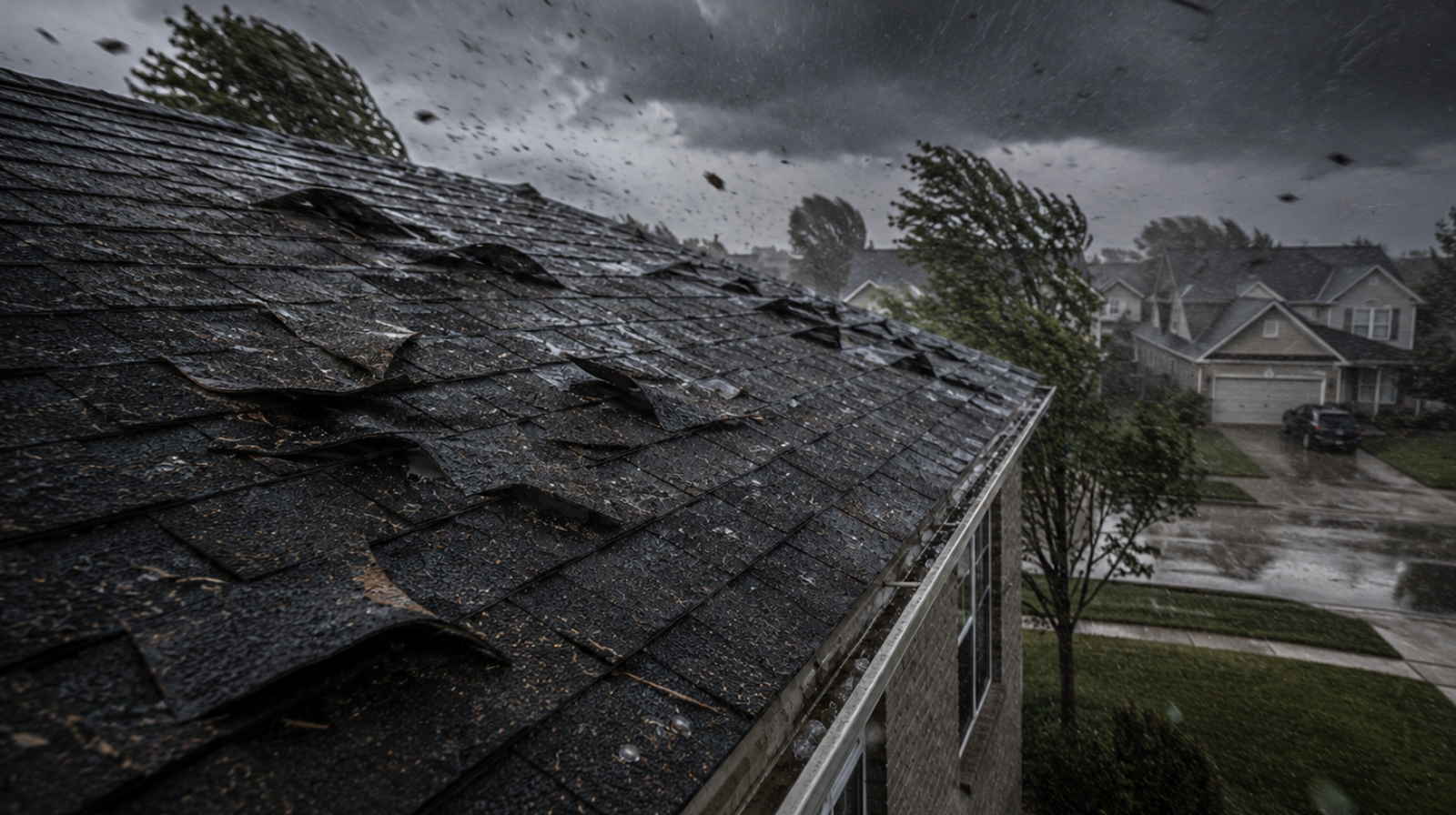
When most people picture wind damage roof repair, they imagine shingles blowing completely off the roof and landing somewhere in the yard.
That certainly happens, especially during the stronger storms we experience throughout Ohio. But in many cases, the damage begins long before a shingle ever leaves the roof.
Modern asphalt shingles are designed to overlap and seal tightly against one another, creating a continuous barrier that protects the layers beneath. During periods of high wind, those shingles can flex just enough for the adhesive seal to break. Once that bond is compromised, the shingle may settle back into place and appear perfectly normal from the ground. To the homeowner, nothing looks different.
To an experienced roofing professional, the roof tells a different story.
A broken seal changes how that section of the roof responds during future storms. Each subsequent wind event has a greater opportunity to lift the weakened shingle, allowing moisture to work beneath the roofing system where it was never intended to go. The process is gradual, which is one reason homeowners are often surprised when a leak appears weeks or even months after a storm has passed.
Ohio's climate makes this progression even more significant. Our roofs rarely experience a single type of weather. Instead, they endure cycles of wind, rain, humidity, freezing temperatures and summer heat, often within surprisingly short periods of time. A roofing system weakened by one storm may not fail until it encounters the next one.
That is why timing matters.
A professional inspection after severe weather isn't simply about documenting visible damage. It's about identifying the small changes that could become much larger repairs if they remain hidden beneath the surface.
Understanding how each component of a roofing system works together is equally important. Shingles are only one part of a much larger assembly that includes underlayment, flashing, ventilation and water barriers. When one component is compromised, the performance of the entire system can begin to change. Our Roofing Materials Guide explains how those components work together and why evaluating the roof as a complete system leads to better long-term decisions.
The First Twenty-Four Hours Matter More Than Most People Think
One question homeowners ask us regularly after severe weather is whether they should call immediately or simply wait to see if any problems develop. There isn't a universal answer because every storm and every roof is different. However, there is one principle that almost always proves true. Information gathered early is more valuable than information gathered later.
Photographs taken shortly after a storm provide clearer documentation. Loose shingles are easier to identify before additional weather shifts them again. Debris patterns often reveal how wind moved across the property. Even something as simple as noticing where granules accumulated around downspouts can help tell the story of what occurred overhead.
None of that means every homeowner needs emergency roof repair after every thunderstorm. It simply means that uncertainty is easier to address while the evidence is still fresh.
The homeowners who tend to experience the least stress after major storms are rarely the ones who panic first. They are the ones who replace assumptions with information. They take a careful look around the property, document what they see, and ask someone with experience to help interpret what the roof is saying before making any significant decisions.
That approach doesn't just protect the roof.
It protects the homeowner from making decisions based on fear, speculation or incomplete information.